Research Overview
My research develops nonlinear control methods for robotic and autonomous systems, with current interests in safety-critical control, extremum and source seeking, and cooperative control of nonholonomic and underactuated systems.
Research Areas
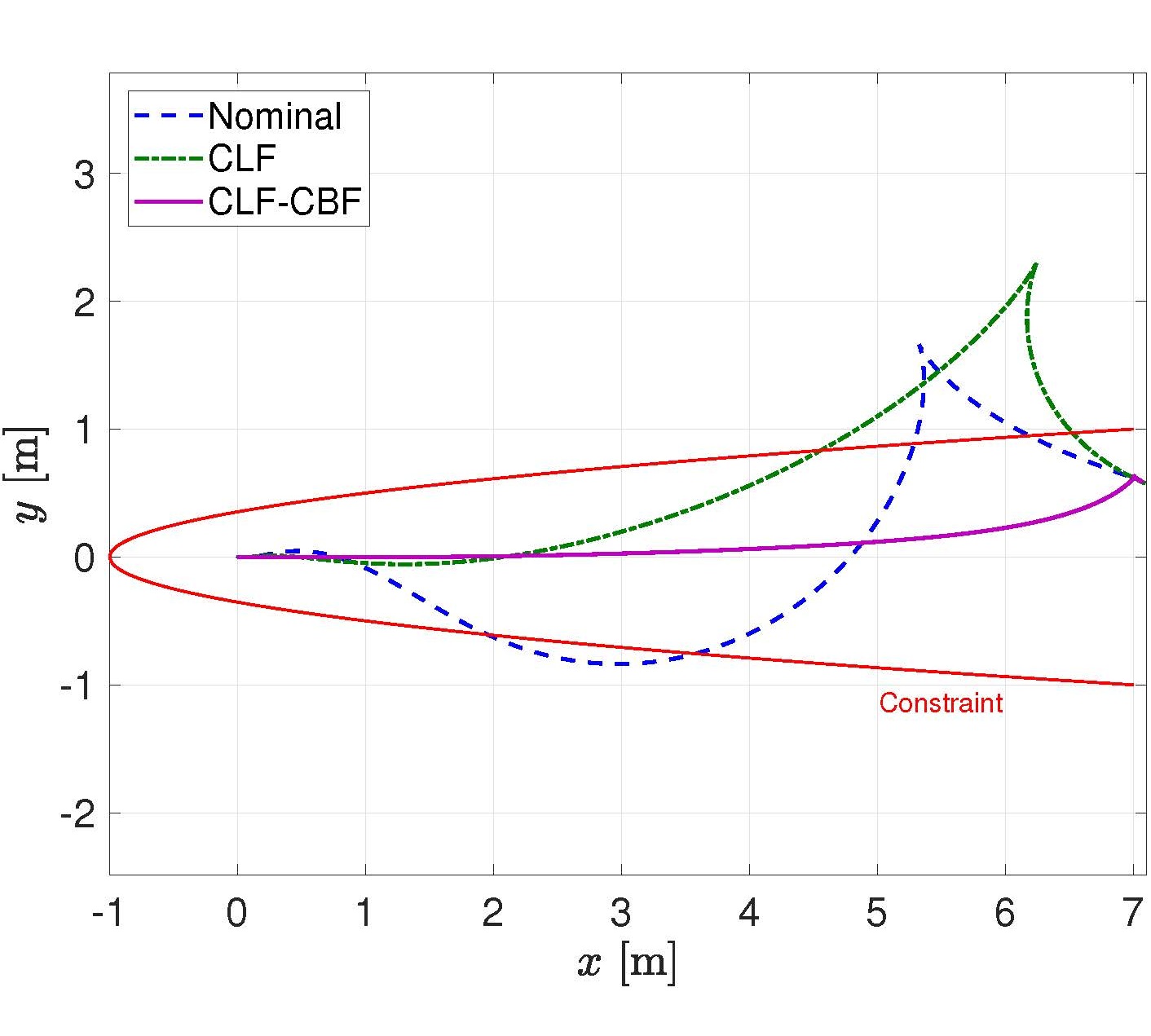 |
Safety-Critical Control and Autonomous Systems We develop constructive methods for safety-critical autonomous systems, with the goal of achieving reliable operation in the presence of dynamical constraints, limited actuation, uncertainty, and complex environments. Our research combines nonlinear control, stability theory, and safety analysis to study fundamental questions in safe stabilization, constraint satisfaction, and autonomous decision making. Particular attention is given to the systematic design of controllers and certificates that provide rigorous guarantees of safety and stability while remaining suitable for implementation on robotic systems. We are also interested in robustness, feasibility, and compositional properties of safety-critical control methods, especially for systems with nonlinear, nonholonomic, underactuated, or networked dynamics. These ideas are applied to a broad range of autonomous systems, including mobile robots, autonomous vehicles, multi-agent systems, and other safety-critical robotic platforms. Selected Publications:
|
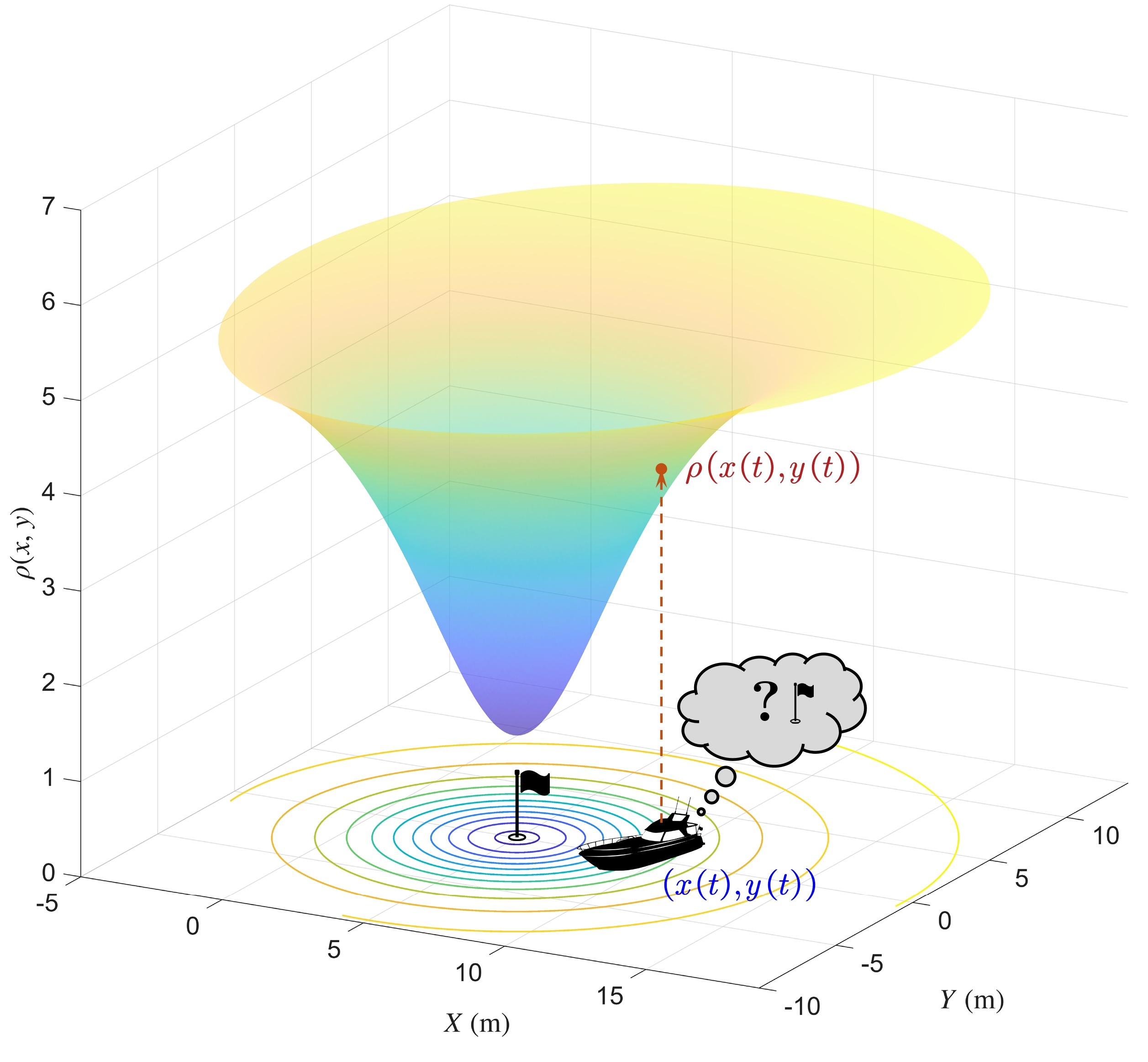 |
Extremum Seeking and Source Seeking for Autonomous Systems We develop extremum seeking and source seeking methods for autonomous systems operating with limited sensing and without direct position information. Our research investigates measurement-driven control strategies for mobile robots and underactuated systems using tools from averaging, symmetric-product approximations, nonlinear systems theory, and stability analysis. These methods rely primarily on real-time measurements of an unknown signal field and are designed to provide rigorous convergence guarantees under practical sensing and actuation constraints. Current interests include source seeking for nonholonomic and underactuated vehicles, extremum-seeking-based motion control, and autonomous search with partial or intermittent measurements. Potential applications include environmental monitoring, localization, search and rescue, signal tracking, and autonomous sensing in GPS-denied environments. Selected Publications:
|
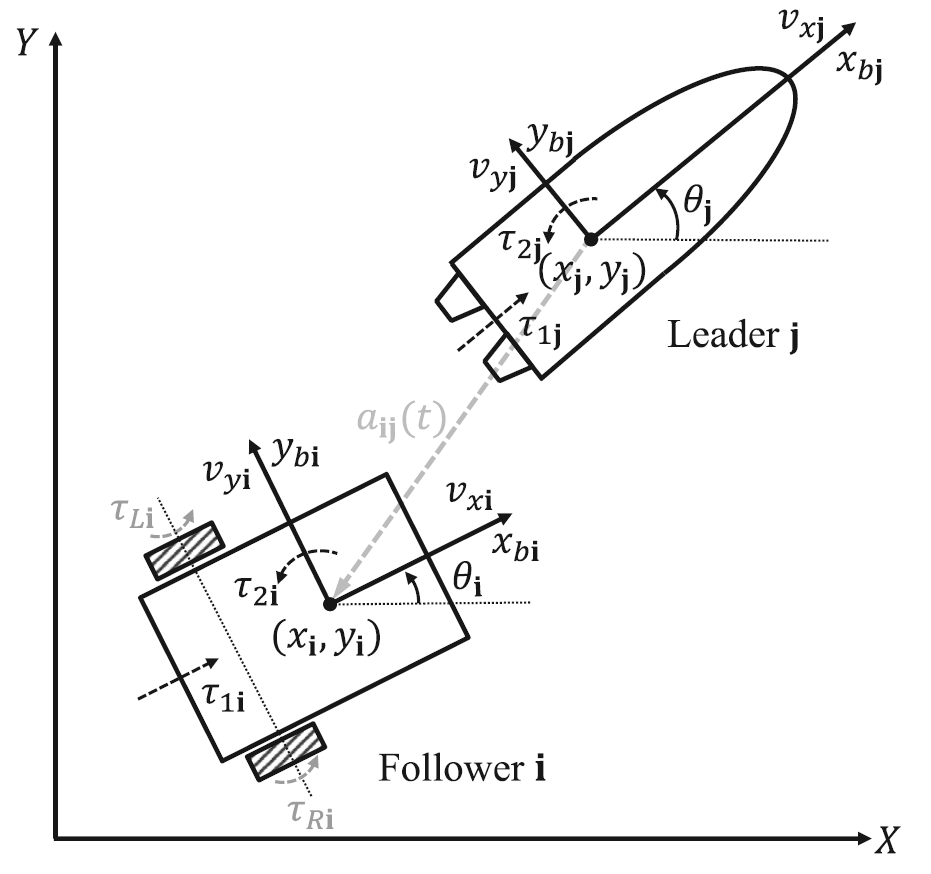 |
Networked and Underactuated Robotic Systems We develop distributed and nonlinear control methods for networked robotic systems with heterogeneous dynamics, limited actuation, and restricted sensing or communication. Our research focuses on coordination, formation control, stabilization, and tracking for multi-agent systems composed of nonholonomic, underactuated, and heterogeneous vehicles. Particular attention is given to control architectures that rely on local information and remain effective without global position measurements or centralized coordination. We are interested in both the fundamental properties of networked nonlinear systems and the design of scalable control strategies for cooperative autonomy. Applications include teams of mobile robots, surface vessels, aerial and space vehicles, and other multi-agent robotic systems operating in uncertain or communication-constrained environments. Selected Publications:
|
Research Collaborators
Hashem Ashrafiuon
Department of Mechanical Engineering, Villanova University, PA (Doctoral Advisor)
Baicang Guo
School of Vehicle and Energy, Yanshan University, China
Miroslav Krstic
Department of Mechanical and Aerospace Engineering, University of California San Diego, CA
Chong Li
College of Engineering, Ocean University of China, China
Yiqiao Li
Department of Civil Engineering, The City College of New York, NY
Antonio Loria
Laboratoire des Signaux et Systèmes (L2S), CNRS, France
Peiman Naseradinmousavi
Department of Mechanical Engineering, San Diego State University, CA
Sergey G. Nersesov
Department of Mechanical Engineering, Villanova University, PA (Doctoral Advisor)
Guangwei Wang
School of Mechanical Engineering, Guizhou University, China
Chengxi Zhang
School of Internet of Things Engineering, Jiangnan University, China